Making MSNs Meaningful: Insights From Dr. Courtney Wayland
Written by:
University of Tulsa
• Nov 19, 2025
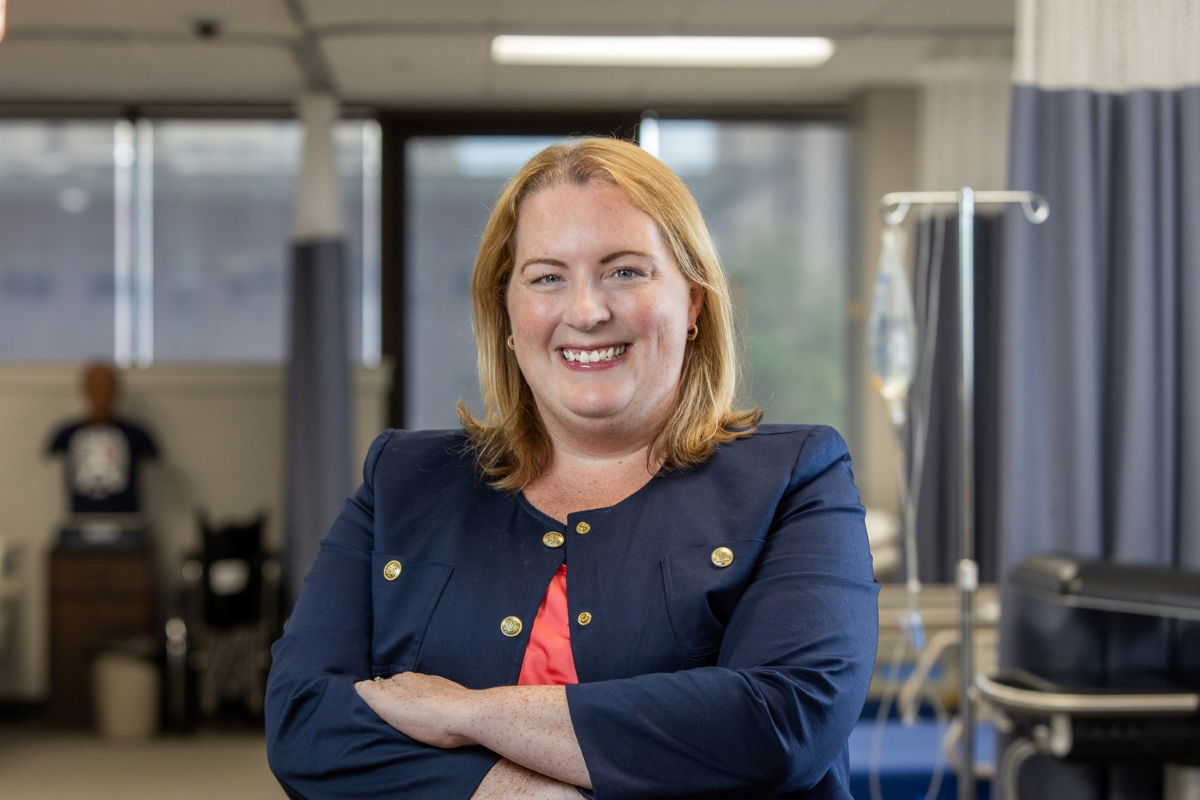
Dr. Courtney Wayland, DNP, RN, CNE, knew early on that she wanted to get into health care. At first, she had her hopes set on becoming a physician. One formative experience in junior high changed that.
“I got a volunteer position at a very small local community hospital as a candy striper. I wore the apron and everything and the little hat,” she recalls with a laugh. “Once I got into that, what I kept noticing was that the doctors were wonderful, but they were in and out with the patients. The people who really knew what was going on were the nurses.”
Since then, Wayland, a self-described people person with a natural love of helping people, has held an impressively varied selection of roles in the nursing world. In addition to working in both classrooms and clinical settings, she’s worked on research to improve evidence-based interventions for patients with dementia and initiatives that bring much-needed health care services to the unhoused population in Tulsa, Oklahoma.
Today, she’s the director of the Master of Science in Nursing (MSN) program at The University of Tulsa, as well as an instructor and student adviser for all of the university’s MSN students. Her past experiences have helped her shape TU’s new online MSN program into something truly unique, impactful, and tailored to the needs of today’s nursing students.
Helping Students Balance Work, School, and Life
Wayland started her career as an RN on a cardiac care unit in 2006. Very quickly, though, she became a charge nurse and started taking on more responsibilities.
“As a charge nurse, I would often be a nurse preceptor for nursing students,” she says. “I loved that. And so I thought, ‘That would be great to do as a full-time career.’”
Driven by this newfound passion, Wayland enrolled in an MSN Education program in 2006. As much as she loved it, though, that period wasn’t without its challenges.
“I was still working full-time while I did my master’s,” she remembers. “It was a hard balance to strike. It took me two and a half years to complete my program.”
The online and often asynchronous format of TU’s MSN program gives students much-needed flexibility, but given her experience, Wayland and her colleagues also decided to change up how classes are scheduled.
“Our courses are eight weeks in length,” she says. “If our students want to go full time and want to be extremely focused and dedicated, they can finish their master’s in as little as a year.”
Keeping the Curriculum Up to Date and Career Focused
While Wayland and the TU team wanted to give their MSN students some breathing room, it was equally important to maintain academic rigor.
“Even though our MSN program is new at The University of Tulsa, our School of Nursing has a 50-plus-year history,” she says. “We know nursing, and we take a lot of pride in what it means to be a TU nurse.”
However, Wayland is not one to rest on her laurels. To her, honoring the TU nursing tradition means keeping the curriculum up to date and career focused.
“One of the changes that has taken place that I think is actually for the best is a new focus on what we call the three P’s — pathophysiology, health promotion, and pharmacology,” she says. “It really adds a layer of rigor to the MSN that wasn’t necessarily present when I was doing my MSN. Having that more in-depth knowledge about those three things really helps you to be a stronger nurse in your practice.”
Meeting Students’ Career Development Needs
While clinical skills are a key part of TU’s MSN curriculum, Wayland noticed very quickly that her students need much more than that to excel in today’s health care sector. Many students, she says, have recently accepted leadership positions and feel a little overwhelmed by their new duties.
“They have all this fantastic bedside clinical knowledge, but they find that they’re missing some pieces in leadership, in budgeting, in finance, in strategic planning — things that are really necessary to perform at those higher levels of leadership.”
To serve those students, TU’s online MSN program offers a Leadership and Innovation specialty track. It includes courses on all of the subjects Wayland mentions, as well as the core MSN curriculum.
Creating Impactful, Hands-on Experiences
One of the other specialty tracks TU students can choose is Public Health Global Vision, a track that emphasizes population-level wellness and epidemiology. Public health degree concentrations aren’t uncommon, but TU gives public health specialists the chance to gain meaningful firsthand experience.
“We have a model called Scrubs, and it’s focused on getting nursing students out into service learning projects in the community,” Wayland says. “Right now, we mainly work with the homeless population at a shelter in downtown Tulsa. We go there every Thursday and provide baseline health assessments. This semester, I am bringing several of my graduate students into this experience, as well.”
However, even if students don’t have time to participate in the Scrubs model, Wayland is wholly dedicated to ensuring that everyone has access to truly impactful hands-on learning experiences.
“Being the student adviser helps me get to know each one of the students,” she says. “If I know what their interests are and what their passions are, that also helps me in lining up a practicum experience for them that could be really powerful.”
Get the Skills and Mentorship You Need to Excel in Nursing
Over the course of her career, Dr. Courtney Wayland, DNP, RN, CNE, has certainly accomplished plenty to be proud of. However, one of the things she’s most proud of is bringing a sense of community to TU’s online Master of Science in Nursing students, something she says online programs often struggle with.
“You have to be more intentional with that in an online environment. We do a good job with that here at TU,” she says. “Some people dread group work, but we try to use it judiciously. I want my students to make good contacts. You know, these are their peers, these are going to be fellow leaders in academia, in health care, and in the community. I want them to have a strong network.”
To find out how you can join that community and take your nursing career to the next level, request more information or contact the admissions team today.
Recommended Readings:
How an MSN Can Increase Autonomy in Nursing